Select your area
Select your area
Select your area
Select your area
Select your area
Select your area

When Jayplas – one of the UK’s largest independent specialist plastic recyclers, converters, and recycled plastic packaging manufacturers – acquired new warehouse premises in Swansea, they brought in Rase Steels as one of the main contractors to manage the regeneration of the site.
The warehouse, formerly used to produce painted plastic car parts, was purchased by JayPlas after its closure in 2021. The site once housed a large painting facility, and its removal left several floors with trenches up to 3m deep. As part of the regeneration programme to transform the site into a bespoke plastic recycling facility, Rase Steels were appointed to carry out the remedial works, including reinstating the floors to a safe and functional condition.
Having worked with Rase Steels on projects across Great Britain, Breedon was appointed to supply a specialist foamed concrete mix to fill the trenches, followed by a 200mm structural concrete slab to provide
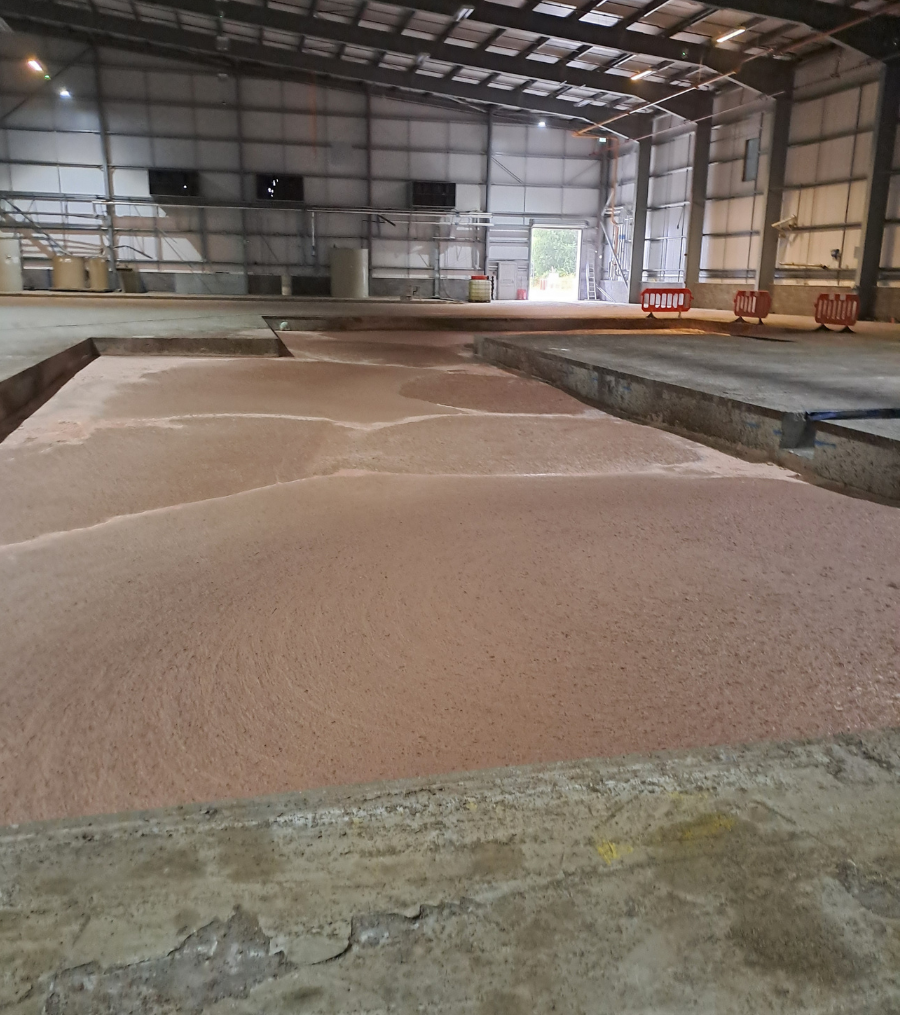
The trenches reached depths of up to 3m and were irregular in shape, requiring Rase Steels to source a suitable low grade filling agent to bring them back to level.
While these types of voids are often filled using MOT Type 1, this approach was not practical. The material would need to be placed and compacted in layers, but the depth and geometry of the trenches, combined with limited site access, made it impossible to bring in the equipment required for offloading and compaction. In addition, installing Type 1 in such confined conditions would be time consuming and labour intensive, ultimately increasing both project duration and overall installation costs.
Access constraints added further complexity. The warehouse could only be entered through a narrow shutter door, leaving minimal room to manoeuvre machinery or bulk materials inside.
Additionally, the fill material needed to remain stable at significant depths without risk of segregation or settlement issues over time. Achieving a consistent mix throughout the full depth of the trenches was critical to preventing structural weaknesses or the formation of internal voids.
To address the project challenges, Rase Steels worked with Breedon to identify a solution that could be safely delivered and perform reliably at depth. Following an assessment of the site and its access constraints, Breedon Foam™, a lightweight, free-flowing, foamed concrete designed for trench reinstatement, was selected.
Over eight days, 1,473 m³ of Breedon Foam™ was supplied, averaging 300 m³ per day. Its low density and high flowability allowed it to be poured directly into the deep, irregular trenches without the need for compaction equipment. The concrete mix was produced at a nearby Breedon plant with the admixture incorporated during batching. Due to the rapid discharge rate, loads were scheduled every 15 minutes using a just-in-time approach, supported by eight delivery trucks rotating daily to maintain a continuous supply.
Site access was assessed in advance, and a trial run confirmed that delivery vehicles could safely enter the warehouse and reach the trench locations.
The mix incorporated CEM II/A-L cement, reducing carbon emissions compared to standard concrete. Breedon’s technical team monitored the mix throughout production and placement to ensure it met the required technical specification.
After the trenches were filled, a 100 m³ C28/35 CEM II/A-L S3 pump concrete mix was used to form the structural slab and bring the floor to level.
In addition to meeting all technical requirements, Breedon Foam™ reduced manual labour and eliminated noise and vibration from compaction equipment, providing a faster and safer solution.
Breedon Foam™ supplied
poured on average every day